Despite borrowing massive amounts of money, the government still needs to find ways to raise revenue to pay for new programs and spending. The current democratically controlled Congress is looking to potentially implement new social programs and a climate bill. As a way of funding these initiatives, they are considering an expansion of the Net Investment Income Tax (NIIT).
The NIIT is proposed to raise revenue since it is seen as politically more palatable, given that it typically only impacts a small group of wealthier taxpayers. Critics, however, say the plan in its current form would also hurt small family businesses.
Who Pays NIIT Now?
Under the Affordable Care Act (ACA), the NIIT applied a 3.8 percent tax on investment income. Investment income includes both passive sources like dividends, capital gains, interest, royalties, and rents as well as passive business income. Under the ACA, the NIIT applied only to single taxpayers earning $200k or more and joint filers with $250k or more.
When it comes to the taxability of business income under the NIIT, because the law only captures passive business income, most owners of pass-through entities must pay the NIIT; however, active owners of S-corporations are exempt. Likewise, if someone qualifies as a real estate professional, their income is considered active and so their rental income is also exempt.
Who Would Pay Under the New Proposed Law?
The current version of the House bill makes two major changes. First, the NIIT expands to capture all business income. Essentially, S-corporation shareholders, limited partners, and pass-through entity owners that are currently exempt would be impacted.
Second, when it comes to removing the exemption on this business income, the income threshold rises from $200k to $400k for single filers and from $250k to $500k for taxpayers filing jointly. The effect of this would be to exclude most business owners from the tax, but make filing more complex for those impacted.
Under the new rules, the Tax Policy Center projects that in 2023 the tax hike would fall on those in the top 1 percent of household incomes or those making approximately $885k or more. Further, even among the top 1 percent, more than 50 percent of the tax increase would be borne by the top 0.1 percent for those making $4 million and up.
Impact No Small Businesses
Overall, about 14 percent of taxpayers report some form of business income on their federal tax returns. The amount reported, however, is usually not a material amount for most as a percentage of their income. For example, only approximately 5.5 percent of taxpayers with reported business income had this as the source of 50 percent or more of their total income. As a result, the impact will be mostly on a small percentage of small businesses. At the same time, as business income is far more variable than employment income, someone could easily fall in and out of the tax range.
Conclusion
Overall, the House bill looks to raise the threshold of where the NIIT expansion applies by the type of income it captures. We will have to wait and see if there are changes as the bill makes its way through – if it even passes at all. No matter what happens, there will certainly be tax increases of some kind.
Expanding the Net Investment Income Tax
August 1, 2022 · Blog, Tax and Financial News
⏱ 3 min read
Despite borrowing massive amounts of money, the government still needs to find ways to raise revenue to pay for new programs and spending. The current democratically controlled Congress is looking to potentially implement new social programs and a climate bill. As a way of funding these initiatives, they are considering an expansion of the Net Investment Income Tax (NIIT).
The NIIT is proposed to raise revenue since it is seen as politically more palatable, given that it typically only impacts a small group of wealthier taxpayers. Critics, however, say the plan in its current form would also hurt small family businesses.
Who Pays NIIT Now?
Under the Affordable Care Act (ACA), the NIIT applied a 3.8 percent tax on investment income. Investment income includes both passive sources like dividends, capital gains, interest, royalties, and rents as well as passive business income. Under the ACA, the NIIT applied only to single taxpayers earning $200k or more and joint filers with $250k or more.
When it comes to the taxability of business income under the NIIT, because the law only captures passive business income, most owners of pass-through entities must pay the NIIT; however, active owners of S-corporations are exempt. Likewise, if someone qualifies as a real estate professional, their income is considered active and so their rental income is also exempt.
Who Would Pay Under the New Proposed Law?
The current version of the House bill makes two major changes. First, the NIIT expands to capture all business income. Essentially, S-corporation shareholders, limited partners, and pass-through entity owners that are currently exempt would be impacted.
Second, when it comes to removing the exemption on this business income, the income threshold rises from $200k to $400k for single filers and from $250k to $500k for taxpayers filing jointly. The effect of this would be to exclude most business owners from the tax, but make filing more complex for those impacted.
Under the new rules, the Tax Policy Center projects that in 2023 the tax hike would fall on those in the top 1 percent of household incomes or those making approximately $885k or more. Further, even among the top 1 percent, more than 50 percent of the tax increase would be borne by the top 0.1 percent for those making $4 million and up.
Impact No Small Businesses
Overall, about 14 percent of taxpayers report some form of business income on their federal tax returns. The amount reported, however, is usually not a material amount for most as a percentage of their income. For example, only approximately 5.5 percent of taxpayers with reported business income had this as the source of 50 percent or more of their total income. As a result, the impact will be mostly on a small percentage of small businesses. At the same time, as business income is far more variable than employment income, someone could easily fall in and out of the tax range.
Conclusion
Overall, the House bill looks to raise the threshold of where the NIIT expansion applies by the type of income it captures. We will have to wait and see if there are changes as the bill makes its way through – if it even passes at all. No matter what happens, there will certainly be tax increases of some kind.
Disclaimer
These articles provide general information on tax, accounting, and financial topics for small businesses and individuals. They are educational in nature and are not specific legal, accounting, financial, tax, or other professional advice, and should not be relied upon as such. This content was prepared by Service2Client and may have been reviewed or edited by the website owner for accuracy and compliance. Look for a trust mark below for verification details. No representation is made that any approach described will achieve a particular result, and no regulatory or professional body has reviewed or endorsed this content. Because each situation is different, readers should consult a qualified professional about their specific circumstances before acting. Images accompanying these articles are protected by copyright and may not be copied or reused.
Whether it’s tariffs, trade wars, or post-pandemic inflation caused by kink-ridden supply chains and what many experts believe to be excess money printing, inflation is an insidious drag on businesses’ operations. When it comes to energy’s contribution to inflation, the U.S. Energy Information Administration (EIA) reports that crude and natural gas prices in 2022 have increased on an annualized and weekly basis. Looking at the snapshot of 7/21/2022, WTI crude on the futures market was $96.35 a barrel. This was up more than $26 compared to 12 months ago, and $0.57 higher than a week earlier. For the same time frame, natural gas futures were $7.932/MMBtu, an increase of $3.973 from 12 months ago and an increase of $1.332 from a week earlier.
When it comes to businesses using any type of commodity, they’re faced with the question of how to raise retail prices when their prices increase. However, many business owners are hesitant to increase prices on their goods and services as they fear it will drive away customers. But in light of increasing input prices, not implementing price increases correctly will impact a business’s earnings and profitability.
As McKinsey & Company explains, there are many considerations why businesses have had trouble with mitigating costs in light of rising input costs. It’s important to monitor raw material costs with a fine-tooth comb. Businesses that bury costs of commodities, labor or tariffs under general accounting categories hide spikes in input costs due to factoring ancillary costs. If volatile input or uncontrollable factors, however, like tariffs can be monitored independently and in real time, businesses are more likely to be able to increase prices – and do so more gradually. With this in mind, McKinsey & Company highlighted four practices that businesses can implement to combat pressure from input costs and pushback from customers who question the reason for price increases.
1. Create a Database of Dynamic Costs
By looking at historical records going back as far as 36 months, businesses can determine trends and keep track of increases or decreases of input materials to share with the sales and customer service department, who can then communicate with customers. Along with looking at how contracts are written and if there are escalator clauses that permit conditions to adjust for increases in input materials, taking steps to accurately measure the impact of raw material costs can be helpful for price increase considerations.
It could look at costs by department. If a plating department at a manufacturing company plates 50,000 pieces of metal a month, incurs $200,000 of direct material costs and has $50,000 in labor and overhead costs, it can be broken down into a per unit cost of $4 for materials and $1 of labor and overhead costs. If the per unit cost of materials fluctuates, investigation can occur through the supply chain from the supplier to the price of futures contracts to see if prices can be negotiated or must be increased for customers.
2. Mind the Economy
Businesses are advised to keep an eye on current economic conditions. This is how companies can set a dynamic pricing strategy. Building on the first step, it’s advised to index prices to those of commodities to reduce the lag time between when companies experience changes in costs for their input materials and when retail prices actually reflect the true cost to the company. Be it fuel, wood, coffee or metals, understanding how the price of commodities fluctuates in real time is essential to determine when and how to adjust prices for retail customers. It also can help businesses determine how competitors are adjusting their pricing to customers, how far prices could increase, and how to augment delivery of goods or services to stay competitive and profitable.
In addition to escalation clauses, companies adapting to changing input material prices could, for example, introduce shorter-term contracts, look for more competitive suppliers, or substitute different but equal quality/performance materials.
3. Coaching Staff to Educate and Explain Price Fluctuations
Continual evaluations for sales teams are imperative. Supervisors must see what accounts have (and have not) been informed of price increases. They should focus on what accounts have accepted price increases (and what level of price increases have been accepted). They also should look at what accounts are likely to accept price increases and what accounts are not likely to accept price increases. Businesses also must factor in the business cycle for the sales process and how each account is performing relative to its price increase targets due to cyclical increases in input commodity prices and interest rates for financing availability. Ongoing coaching should be implemented to identify major issues and ways to resolve them. Anticipating and preparing sales representatives for customer questions through role playing can help better prepare employees to explain why price increases are a part of doing business.
4. Managing Performance
Businesses must play the long game after products or services have been priced accordingly to commodity and input prices. Since inflation follows the economic cycle, upside and downside pricing dynamics can catch companies off guard. Consistently updated product or service pricing systems and prepared sales teams can lead to more profitable margins and hopefully the ability to weather volatile and long-term price spikes.
Much like the price of commodities and labor fluctuate based on dynamic market conditions, finding ways to adapt one’s business practices can increase chances of surviving and thriving in a challenging economy.
How Businesses Can Mitigate Inflation & Maintain Pricing Power
August 1, 2022 · Blog, General Business News
⏱ 5 min read
Whether it’s tariffs, trade wars, or post-pandemic inflation caused by kink-ridden supply chains and what many experts believe to be excess money printing, inflation is an insidious drag on businesses’ operations. When it comes to energy’s contribution to inflation, the U.S. Energy Information Administration (EIA) reports that crude and natural gas prices in 2022 have increased on an annualized and weekly basis. Looking at the snapshot of 7/21/2022, WTI crude on the futures market was $96.35 a barrel. This was up more than $26 compared to 12 months ago, and $0.57 higher than a week earlier. For the same time frame, natural gas futures were $7.932/MMBtu, an increase of $3.973 from 12 months ago and an increase of $1.332 from a week earlier.
When it comes to businesses using any type of commodity, they’re faced with the question of how to raise retail prices when their prices increase. However, many business owners are hesitant to increase prices on their goods and services as they fear it will drive away customers. But in light of increasing input prices, not implementing price increases correctly will impact a business’s earnings and profitability.
As McKinsey & Company explains, there are many considerations why businesses have had trouble with mitigating costs in light of rising input costs. It’s important to monitor raw material costs with a fine-tooth comb. Businesses that bury costs of commodities, labor or tariffs under general accounting categories hide spikes in input costs due to factoring ancillary costs. If volatile input or uncontrollable factors, however, like tariffs can be monitored independently and in real time, businesses are more likely to be able to increase prices – and do so more gradually. With this in mind, McKinsey & Company highlighted four practices that businesses can implement to combat pressure from input costs and pushback from customers who question the reason for price increases.
1. Create a Database of Dynamic Costs
By looking at historical records going back as far as 36 months, businesses can determine trends and keep track of increases or decreases of input materials to share with the sales and customer service department, who can then communicate with customers. Along with looking at how contracts are written and if there are escalator clauses that permit conditions to adjust for increases in input materials, taking steps to accurately measure the impact of raw material costs can be helpful for price increase considerations.
It could look at costs by department. If a plating department at a manufacturing company plates 50,000 pieces of metal a month, incurs $200,000 of direct material costs and has $50,000 in labor and overhead costs, it can be broken down into a per unit cost of $4 for materials and $1 of labor and overhead costs. If the per unit cost of materials fluctuates, investigation can occur through the supply chain from the supplier to the price of futures contracts to see if prices can be negotiated or must be increased for customers.
2. Mind the Economy
Businesses are advised to keep an eye on current economic conditions. This is how companies can set a dynamic pricing strategy. Building on the first step, it’s advised to index prices to those of commodities to reduce the lag time between when companies experience changes in costs for their input materials and when retail prices actually reflect the true cost to the company. Be it fuel, wood, coffee or metals, understanding how the price of commodities fluctuates in real time is essential to determine when and how to adjust prices for retail customers. It also can help businesses determine how competitors are adjusting their pricing to customers, how far prices could increase, and how to augment delivery of goods or services to stay competitive and profitable.
In addition to escalation clauses, companies adapting to changing input material prices could, for example, introduce shorter-term contracts, look for more competitive suppliers, or substitute different but equal quality/performance materials.
3. Coaching Staff to Educate and Explain Price Fluctuations
Continual evaluations for sales teams are imperative. Supervisors must see what accounts have (and have not) been informed of price increases. They should focus on what accounts have accepted price increases (and what level of price increases have been accepted). They also should look at what accounts are likely to accept price increases and what accounts are not likely to accept price increases. Businesses also must factor in the business cycle for the sales process and how each account is performing relative to its price increase targets due to cyclical increases in input commodity prices and interest rates for financing availability. Ongoing coaching should be implemented to identify major issues and ways to resolve them. Anticipating and preparing sales representatives for customer questions through role playing can help better prepare employees to explain why price increases are a part of doing business.
4. Managing Performance
Businesses must play the long game after products or services have been priced accordingly to commodity and input prices. Since inflation follows the economic cycle, upside and downside pricing dynamics can catch companies off guard. Consistently updated product or service pricing systems and prepared sales teams can lead to more profitable margins and hopefully the ability to weather volatile and long-term price spikes.
Much like the price of commodities and labor fluctuate based on dynamic market conditions, finding ways to adapt one’s business practices can increase chances of surviving and thriving in a challenging economy.
These articles provide general information on tax, accounting, and financial topics for small businesses and individuals. They are educational in nature and are not specific legal, accounting, financial, tax, or other professional advice, and should not be relied upon as such. This content was prepared by Service2Client and may have been reviewed or edited by the website owner for accuracy and compliance. Look for a trust mark below for verification details. No representation is made that any approach described will achieve a particular result, and no regulatory or professional body has reviewed or endorsed this content. Because each situation is different, readers should consult a qualified professional about their specific circumstances before acting. Images accompanying these articles are protected by copyright and may not be copied or reused.
Even though summer is still somewhat in full swing, school will be starting soon. Yes, you heard that right. This means that you probably need to get prepared for the inevitable cash outlay ahead. But it doesn’t have to cost an arm and a leg. Here are some ways to navigate the upcoming expenditures and save a penny or two.
Start Early
We’re talking a few weeks ahead, if possible. If you wait until the last minute, supplies might run out. You may have to spend time online searching and/or driving from store to store – and paying the premium both in terms of products and gas. If you spread out purchases a little at a time, you won’t feel the financial hit so severely. Dive in early and you’ll thank yourself when it’s all over.
Conduct a Supply Audit
Dig into those drawers, closets and storage bins for school supplies from last year. Chances are, you bought a set of, say, pencils and all are not used. When you’re done, put what you’ve found in a central location and make your shopping list. Be sure to keep this list handy (on your phone, or in your bag if you’ve handwritten it). Another way to keep track of what you already have is to snap a pic of it.
Swap With Friends
Do this before you spend any money. Organize a small gathering with other parents, trade your wares, figure out what you need, then get going.
Head to the Dollar Store
After you’ve audited and swapped, check out these bargain basement stores. Here, you’ll find big savings on basics like notebooks, pencils, plus hand sanitizer and facial tissues.
Scour Thrift Stores
While thrift stores might not have supplies in terms of schoolwork, they’ll definitely have back-to-school clothes you can buy for a song – aka pretty darn cheap. You might look for backpacks here, too, which are a must-have. Tip: Don’t let your kiddos wear their new duds immediately. Save them for the first day (and days after) so they’ll feel like they’re starting the new year with a 100 percent fresh start.
Shop on a Sales Tax Holiday
Lots of states have these and during this time (or day or weekend), you can buy computers, clothing and school supplies without paying sales tax. Here’s a state sales tax holiday list for you.
Follow Popular Stores on Social Media
Many companies send their followers coupon links and advance notice about juicy sales. Several to watch on Facebook and Twitter are Staples, Office Depot, Target, Best Buy, as well as Coupons.com and RetailMeNot.
Make One Trek Solo
While taking the kiddos along can be fun and a great bonding experience, chances are they’ll plop things in your cart you might not want – and run up the bill. By yourself, you can get in and out quickly and control the cost.
Going back to school can be a challenging transition, both for kids and parents. However, if you plan ahead and stay on track, you can give yourself an A+ for all you’ve accomplished.
Even though summer is still somewhat in full swing, school will be starting soon. Yes, you heard that right. This means that you probably need to get prepared for the inevitable cash outlay ahead. But it doesn’t have to cost an arm and a leg. Here are some ways to navigate the upcoming expenditures and save a penny or two.
Start Early
We’re talking a few weeks ahead, if possible. If you wait until the last minute, supplies might run out. You may have to spend time online searching and/or driving from store to store – and paying the premium both in terms of products and gas. If you spread out purchases a little at a time, you won’t feel the financial hit so severely. Dive in early and you’ll thank yourself when it’s all over.
Conduct a Supply Audit
Dig into those drawers, closets and storage bins for school supplies from last year. Chances are, you bought a set of, say, pencils and all are not used. When you’re done, put what you’ve found in a central location and make your shopping list. Be sure to keep this list handy (on your phone, or in your bag if you’ve handwritten it). Another way to keep track of what you already have is to snap a pic of it.
Swap With Friends
Do this before you spend any money. Organize a small gathering with other parents, trade your wares, figure out what you need, then get going.
Head to the Dollar Store
After you’ve audited and swapped, check out these bargain basement stores. Here, you’ll find big savings on basics like notebooks, pencils, plus hand sanitizer and facial tissues.
Scour Thrift Stores
While thrift stores might not have supplies in terms of schoolwork, they’ll definitely have back-to-school clothes you can buy for a song – aka pretty darn cheap. You might look for backpacks here, too, which are a must-have. Tip: Don’t let your kiddos wear their new duds immediately. Save them for the first day (and days after) so they’ll feel like they’re starting the new year with a 100 percent fresh start.
Shop on a Sales Tax Holiday
Lots of states have these and during this time (or day or weekend), you can buy computers, clothing and school supplies without paying sales tax. Here’s a state sales tax holiday list for you.
Follow Popular Stores on Social Media
Many companies send their followers coupon links and advance notice about juicy sales. Several to watch on Facebook and Twitter are Staples, Office Depot, Target, Best Buy, as well as Coupons.com and RetailMeNot.
Make One Trek Solo
While taking the kiddos along can be fun and a great bonding experience, chances are they’ll plop things in your cart you might not want – and run up the bill. By yourself, you can get in and out quickly and control the cost.
Going back to school can be a challenging transition, both for kids and parents. However, if you plan ahead and stay on track, you can give yourself an A+ for all you’ve accomplished.
These articles provide general information on tax, accounting, and financial topics for small businesses and individuals. They are educational in nature and are not specific legal, accounting, financial, tax, or other professional advice, and should not be relied upon as such. This content was prepared by Service2Client and may have been reviewed or edited by the website owner for accuracy and compliance. Look for a trust mark below for verification details. No representation is made that any approach described will achieve a particular result, and no regulatory or professional body has reviewed or endorsed this content. Because each situation is different, readers should consult a qualified professional about their specific circumstances before acting. Images accompanying these articles are protected by copyright and may not be copied or reused.
Non-fungible tokens (NFTs) are rising in demand, and some brands are already generating great results in their campaigns and providing a unique experience to customers. As the hype around NFTs continues, businesses need to understand how they can benefit.
What is an NFT?
An NFT is a valuable digital asset created using blockchain. Unlike cryptocurrencies, NFTs are not mutually interchangeable as each NFT represents a different asset with a different value. Hence, an NFT verifies the authenticity of a non-fungible asset. This means that the purchaser of the asset/product can only use a product. Unlike other digital products, an NFT can’t be duplicated and sold. This is because the non-fungible asset is made into a token with a digital certificate of ownership, creating authenticity and credibility. NFTs could include videos, music, physical products, services, documents, artwork, and even memes.
A non-fungible asset’s value depends on various factors, such as underlying value, ownership history, perception of the buyer, future value, etc.
How NFTs Have Been Used
So far, some industries are already reaping benefits from NFTs. Various cases of NFTs can be found in gaming, music, fashion, sports, and virtual real estate.
The growth of NFTs has been attributed to the fact that humans like to collect things, and since NFTs are designed to be scarce digital assets, this contributes to the high prices. According to research conducted in March 2021 by Morning Consult, a global decision intelligence company, about half of the people who identified themselves as avid physical collectors were interested in NFTs. In addition, users have more control over the asset bought because it cannot be used in any other way or duplicated, making it more valuable.
With such news making the headlines, businesses may wonder how they can benefit from NFTs.
How Can a Business Benefit from NFTs?
Businesses still hesitant about adopting new technologies should start considering creating NFTs that align with their brand image. Below are some ways in which a business can benefit:
1. Brand Visibility
Aside from digital marketing, NFTs provide another way businesses and corporations can drive attention to their brand. For instance, by creating a digital version of your products, you expose it to NFT enthusiasts, some of who might not be aware of your products. NFTs also can be incorporated as part of your brand storytelling, creating unique experiences for your customers, consequently increasing consumer engagements.
2. Authenticity
Many businesses undergo massive losses of revenue due to counterfeit products. With NFTs, businesses can ascertain the authenticity of their products and services. A digital certificate is issued with every transaction and a record is kept on the blockchain. A customer can check the authenticity since the blockchain can be traced to the original seller.
3. Additional Revenue Stream
Businesses can use NFTs as an additional source of income by selling digital forms of their products or services. One way to do this is by creating an early access opportunity before the official product launches, creating a buzz and ensuring the NFT value will rise.
4. Customer Loyalty Program
The versatile nature of NFTs makes them ideal for use in loyalty programs. The tokens can be used as medals for loyal clients or as membership tokens.
5. Prevent Ticket Scams
Many people fall victim to online ticket scams where they buy fake discounted tickets or duplicate tickets of an original event ticket. The money collected doesn’t go to the business, which also affects the event organizers. Customers also risk their credit card information being stolen by scammers. However, turning a ticket into an NFT makes it easy to verify its authenticity and even prevent ticket black markets.
6. Managing Supply Chain
NFTs are positively disrupting the supply chain. By the use of blockchain technology, it’s now easy to trace the entire process of a product lifecycle, from raw material, transportation, manufacturing, and distribution up to the end consumer. Hence, businesses interested in improving transparency and accountability can embrace NFTs to automate their supply chain.
Conclusion
NFT technology is relatively new, and its practical use is still limited. However, the fact that people are willing to spend on them is reason enough why any business should consider leveraging NFTs in its marketing strategies to help boost brand engagement and drive sales.
What Are NFTs and How Can Businesses Benefit?
August 1, 2022 · Blog, What's New in Technology
⏱ 4 min read
Non-fungible tokens (NFTs) are rising in demand, and some brands are already generating great results in their campaigns and providing a unique experience to customers. As the hype around NFTs continues, businesses need to understand how they can benefit.
What is an NFT?
An NFT is a valuable digital asset created using blockchain. Unlike cryptocurrencies, NFTs are not mutually interchangeable as each NFT represents a different asset with a different value. Hence, an NFT verifies the authenticity of a non-fungible asset. This means that the purchaser of the asset/product can only use a product. Unlike other digital products, an NFT can’t be duplicated and sold. This is because the non-fungible asset is made into a token with a digital certificate of ownership, creating authenticity and credibility. NFTs could include videos, music, physical products, services, documents, artwork, and even memes.
A non-fungible asset’s value depends on various factors, such as underlying value, ownership history, perception of the buyer, future value, etc.
How NFTs Have Been Used
So far, some industries are already reaping benefits from NFTs. Various cases of NFTs can be found in gaming, music, fashion, sports, and virtual real estate.
The growth of NFTs has been attributed to the fact that humans like to collect things, and since NFTs are designed to be scarce digital assets, this contributes to the high prices. According to research conducted in March 2021 by Morning Consult, a global decision intelligence company, about half of the people who identified themselves as avid physical collectors were interested in NFTs. In addition, users have more control over the asset bought because it cannot be used in any other way or duplicated, making it more valuable.
With such news making the headlines, businesses may wonder how they can benefit from NFTs.
How Can a Business Benefit from NFTs?
Businesses still hesitant about adopting new technologies should start considering creating NFTs that align with their brand image. Below are some ways in which a business can benefit:
1. Brand Visibility
Aside from digital marketing, NFTs provide another way businesses and corporations can drive attention to their brand. For instance, by creating a digital version of your products, you expose it to NFT enthusiasts, some of who might not be aware of your products. NFTs also can be incorporated as part of your brand storytelling, creating unique experiences for your customers, consequently increasing consumer engagements.
2. Authenticity
Many businesses undergo massive losses of revenue due to counterfeit products. With NFTs, businesses can ascertain the authenticity of their products and services. A digital certificate is issued with every transaction and a record is kept on the blockchain. A customer can check the authenticity since the blockchain can be traced to the original seller.
3. Additional Revenue Stream
Businesses can use NFTs as an additional source of income by selling digital forms of their products or services. One way to do this is by creating an early access opportunity before the official product launches, creating a buzz and ensuring the NFT value will rise.
4. Customer Loyalty Program
The versatile nature of NFTs makes them ideal for use in loyalty programs. The tokens can be used as medals for loyal clients or as membership tokens.
5. Prevent Ticket Scams
Many people fall victim to online ticket scams where they buy fake discounted tickets or duplicate tickets of an original event ticket. The money collected doesn’t go to the business, which also affects the event organizers. Customers also risk their credit card information being stolen by scammers. However, turning a ticket into an NFT makes it easy to verify its authenticity and even prevent ticket black markets.
6. Managing Supply Chain
NFTs are positively disrupting the supply chain. By the use of blockchain technology, it’s now easy to trace the entire process of a product lifecycle, from raw material, transportation, manufacturing, and distribution up to the end consumer. Hence, businesses interested in improving transparency and accountability can embrace NFTs to automate their supply chain.
Conclusion
NFT technology is relatively new, and its practical use is still limited. However, the fact that people are willing to spend on them is reason enough why any business should consider leveraging NFTs in its marketing strategies to help boost brand engagement and drive sales.
Disclaimer
These articles provide general information on tax, accounting, and financial topics for small businesses and individuals. They are educational in nature and are not specific legal, accounting, financial, tax, or other professional advice, and should not be relied upon as such. This content was prepared by Service2Client and may have been reviewed or edited by the website owner for accuracy and compliance. Look for a trust mark below for verification details. No representation is made that any approach described will achieve a particular result, and no regulatory or professional body has reviewed or endorsed this content. Because each situation is different, readers should consult a qualified professional about their specific circumstances before acting. Images accompanying these articles are protected by copyright and may not be copied or reused.
Corporate profits, according to the Bureau of Economic Analysis, grew by $20.4 billion in the final quarter of 2021, a 0.7 percent increase. For the first quarter of 2022, corporate profits fell by 2.3 percent or $66.4 billion. On an annualized basis, corporate profits fell 5.2 percent in 2022, but grew 25 percent in 2021. With the economy facing inflation, the uncertainty of the Russia/Ukraine conflict, and the world working its way out of the COVID-19 pandemic, economic uncertainty abounds. For companies, measuring margins is one way to evaluate performance and strategize ways to survive and thrive in a dynamic economy. Here are a few common margins that businesses can determine to measure their financial performance.
Operating Margin Defined
Also referred to as return on sales, this measures the profit a business makes on a percentage basis, per dollar, from its core operations. It accounts for manufacturing costs that fluctuate, such as paying employees and input stock. The operating margin is determined by obtaining the business’ earnings before interest and taxes (EBIT) and dividing it by its net sales or sales revenue.
Operating Earnings = Revenue – (cost of goods sold (COGS) + overhead expenses, except tax and loan servicing costs)
Assuming a business had $10 million in revenue, $1.5 million of COGS and $750,000 in related overhead expenses, it would be as follows:
Operating Earnings = $10 million – ($1.5 million + $750,000) / $10 million
Operating Earnings = $10 million – ($2.25 million) / $10 million
Operating Earnings = $7.75 million / $10 million = 0.775 or 77.5%
Understanding the Operating Margin
This doesn’t factor in things such as taxes, interest on loans or other non-core business expenses. However, it gives a picture of what’s remaining for its non-core operating expenses, such as servicing outstanding loans. By looking at a company’s past operating margins, the trends can determine a company’s performance. Ways to improve the margin include reducing staff redundancy, negotiating better deals on raw materials or reaching more receptive customers.
Marginal Revenue Product (MRP)
If a piece of equipment or employee can create an output of X (the marginal physical product or MPP) and each additional unit of production sells at Z price (marginal revenue or MR), the MRP of the piece of the new investment is MPP x MR. Accepting that all other costs remain constant, if the business owner pays less than or equal to the MRP, it may be profitable. Otherwise, it’s not a good decision.
Using the example of a furniture manufacturer looking to respond to increased demand, this illustrates how it can guide business decisions. If a new employee can produce 100 tables every week that will retail for $100 per table, this is the MPP. Based on the calculation, the MPP of 100 multiplied by the marginal revenue (MR) of $100 = $10,000. If the business can hire and retain a new employee for less than $10,000 per week to increase their production by 100 tables per week, it can signal a positive investment.
Marginal Cost of Production
This metric is a way for businesses to determine efficient manufacturing costs. Looking at production volume, this calculation can determine if adding an additional unit to production would add profitability by examining fixed and variable costs. Fixed costs don’t change with modifications in production levels.
A static or fixed cost can be spread out over more units of increased production. However, if expanding production capacity requires additional fixed costs, it can add to the marginal cost of production, which will be explained shortly. When it comes to variable costs, as the name implies, as more production occurs, the costs similarly vary.
Assume company A makes widgets with $1 in variable costs and fixed costs of $10,000 per month, producing 5,000 widgets monthly. This would lead to $2 in fixed costs ($10,000 in fixed costs/5,000 widgets).
This final cost per widget comes to $3 ($2 fixed + $1 variable cost).
If company A chose to produce 10,000 widgets a month and they could use existing machinery, employees, etc., their fixed costs would drop to $1 ($10,000 in fixed costs/10,000 widgets).
Assuming the same variable cost of $1 per widget, plus the $1 in fixed costs, it would cost $2 per widget if the 10,000 widgets were produced. However, if additional investments (equipment, etc.) were needed to produce widget 5,001 to 10,000, this consideration would need to be factored in the marginal cost of production. If additional equipment costs $1,000 to increase production, the business would need to factor this in to see if it’s still profitable.
Essentially, if this additional production cost is less than the price of an additional individual unit, there’s the potential for a profit for the business.
Contribution Margin After Marketing (CMAM)
This measures how much cash is earned from a single unit sold after accounting for promotional and variable expenses. Example expenses include input stock, freight, inventory, etc. It’s important to distinguish between pre-planned marketing expenses over a set period of time (per month, quarter, etc.), and variable sales commissions that can fluctuate. CMAM is calculated as follows:
Looking at how much each unit can add to a business’ profitability:
CMAM for every Unit = Sales Revenue for every Unit – Variable Expenses for every Unit – Marketing Expense for every Unit
From there, a business’ net profit or loss can be found using this ratio:
Net Operating Profit = CMAM – Fixed Costs
Considerations
A smaller or negative CMAM is indicative of a product that’s likely uncompetitive. Conversely, a high CMAM, especially over a long time, can indicate the product is well regarded. It can help businesses to determine their most profitable products and/or what products to discontinue, etc.
With economic uncertainty expected to continue, keeping an eye on past, present and future margins is a key way to maintain a business’ chance of thriving in 2022 and beyond.
Corporate profits, according to the Bureau of Economic Analysis, grew by $20.4 billion in the final quarter of 2021, a 0.7 percent increase. For the first quarter of 2022, corporate profits fell by 2.3 percent or $66.4 billion. On an annualized basis, corporate profits fell 5.2 percent in 2022, but grew 25 percent in 2021. With the economy facing inflation, the uncertainty of the Russia/Ukraine conflict, and the world working its way out of the COVID-19 pandemic, economic uncertainty abounds. For companies, measuring margins is one way to evaluate performance and strategize ways to survive and thrive in a dynamic economy. Here are a few common margins that businesses can determine to measure their financial performance.
Operating Margin Defined
Also referred to as return on sales, this measures the profit a business makes on a percentage basis, per dollar, from its core operations. It accounts for manufacturing costs that fluctuate, such as paying employees and input stock. The operating margin is determined by obtaining the business’ earnings before interest and taxes (EBIT) and dividing it by its net sales or sales revenue.
Operating Earnings = Revenue – (cost of goods sold (COGS) + overhead expenses, except tax and loan servicing costs)
Assuming a business had $10 million in revenue, $1.5 million of COGS and $750,000 in related overhead expenses, it would be as follows:
Operating Earnings = $10 million – ($1.5 million + $750,000) / $10 million
Operating Earnings = $10 million – ($2.25 million) / $10 million
Operating Earnings = $7.75 million / $10 million = 0.775 or 77.5%
Understanding the Operating Margin
This doesn’t factor in things such as taxes, interest on loans or other non-core business expenses. However, it gives a picture of what’s remaining for its non-core operating expenses, such as servicing outstanding loans. By looking at a company’s past operating margins, the trends can determine a company’s performance. Ways to improve the margin include reducing staff redundancy, negotiating better deals on raw materials or reaching more receptive customers.
Marginal Revenue Product (MRP)
If a piece of equipment or employee can create an output of X (the marginal physical product or MPP) and each additional unit of production sells at Z price (marginal revenue or MR), the MRP of the piece of the new investment is MPP x MR. Accepting that all other costs remain constant, if the business owner pays less than or equal to the MRP, it may be profitable. Otherwise, it’s not a good decision.
Using the example of a furniture manufacturer looking to respond to increased demand, this illustrates how it can guide business decisions. If a new employee can produce 100 tables every week that will retail for $100 per table, this is the MPP. Based on the calculation, the MPP of 100 multiplied by the marginal revenue (MR) of $100 = $10,000. If the business can hire and retain a new employee for less than $10,000 per week to increase their production by 100 tables per week, it can signal a positive investment.
Marginal Cost of Production
This metric is a way for businesses to determine efficient manufacturing costs. Looking at production volume, this calculation can determine if adding an additional unit to production would add profitability by examining fixed and variable costs. Fixed costs don’t change with modifications in production levels.
A static or fixed cost can be spread out over more units of increased production. However, if expanding production capacity requires additional fixed costs, it can add to the marginal cost of production, which will be explained shortly. When it comes to variable costs, as the name implies, as more production occurs, the costs similarly vary.
Assume company A makes widgets with $1 in variable costs and fixed costs of $10,000 per month, producing 5,000 widgets monthly. This would lead to $2 in fixed costs ($10,000 in fixed costs/5,000 widgets).
This final cost per widget comes to $3 ($2 fixed + $1 variable cost).
If company A chose to produce 10,000 widgets a month and they could use existing machinery, employees, etc., their fixed costs would drop to $1 ($10,000 in fixed costs/10,000 widgets).
Assuming the same variable cost of $1 per widget, plus the $1 in fixed costs, it would cost $2 per widget if the 10,000 widgets were produced. However, if additional investments (equipment, etc.) were needed to produce widget 5,001 to 10,000, this consideration would need to be factored in the marginal cost of production. If additional equipment costs $1,000 to increase production, the business would need to factor this in to see if it’s still profitable.
Essentially, if this additional production cost is less than the price of an additional individual unit, there’s the potential for a profit for the business.
Contribution Margin After Marketing (CMAM)
This measures how much cash is earned from a single unit sold after accounting for promotional and variable expenses. Example expenses include input stock, freight, inventory, etc. It’s important to distinguish between pre-planned marketing expenses over a set period of time (per month, quarter, etc.), and variable sales commissions that can fluctuate. CMAM is calculated as follows:
Looking at how much each unit can add to a business’ profitability:
CMAM for every Unit = Sales Revenue for every Unit – Variable Expenses for every Unit – Marketing Expense for every Unit
From there, a business’ net profit or loss can be found using this ratio:
Net Operating Profit = CMAM – Fixed Costs
Considerations
A smaller or negative CMAM is indicative of a product that’s likely uncompetitive. Conversely, a high CMAM, especially over a long time, can indicate the product is well regarded. It can help businesses to determine their most profitable products and/or what products to discontinue, etc.
With economic uncertainty expected to continue, keeping an eye on past, present and future margins is a key way to maintain a business’ chance of thriving in 2022 and beyond.
These articles provide general information on tax, accounting, and financial topics for small businesses and individuals. They are educational in nature and are not specific legal, accounting, financial, tax, or other professional advice, and should not be relied upon as such. This content was prepared by Service2Client and may have been reviewed or edited by the website owner for accuracy and compliance. Look for a trust mark below for verification details. No representation is made that any approach described will achieve a particular result, and no regulatory or professional body has reviewed or endorsed this content. Because each situation is different, readers should consult a qualified professional about their specific circumstances before acting. Images accompanying these articles are protected by copyright and may not be copied or reused.
Today, businesses have to grapple with vast amounts of data from different sources, including emails, mailing lists, customer orders, system logs, mobile apps, social media networks, etc. This data is crucial to businesses in various ways. When analyzed, a business can identify operational issues, personalize the customer experience and manage supply chains – all contributing to better decision-making.
However, big data also has challenges, especially regarding its storage due to size and other factors such as collection speed, processing, retrieval and format. This becomes more complicated as the data keeps growing with time and cannot be stored in traditional storage devices, necessitating a need for facilities that store and process the data efficiently.
Depending on the business type, a choice can be made between storing data in a warehouse or in the cloud. A data warehouse is a building facility that stores and processes data for a business. This in-house data storage offers the advantage of speed. However, when more space is needed, it will be necessary to acquire more physical storage.
On the other hand, a business may choose to opt for cloud storage. Cloud storage offers the benefit of convenience, accessibility, cost and maintenance, which the service provider handles.
Considerations in Storing Big Data
Regardless of the means a business chooses to store its data, there are various issues to consider:
Understand your data – before choosing a data storage method, it is essential to first understand the company’s data in terms of the type of data collected, quantity, storage period, retrieval speeds, use cases, etc. This helps choose a data management system that can handle the data efficiently.
Data governance – with so much data collected and with data growing exponentially, it is likely that users can be lost in a sea of data. Therefore, a business should define a strategy that aligns with business goals to avoid collecting unnecessary data that takes up storage space.
Data integration tools – data is collected from multiple sources, and it is necessary to have adequate integration tools that allow for different file formats.
Cost – it is difficult to determine the actual cost of storing data. Hence, a business should not base the cost decision on the upfront cost alone. This is because other factors are involved, including operating costs, the need for scalability, training or hiring users, new technologies, and the cost of backup. Businesses must evaluate whether the initial investment in the best data storage technologies is worthwhile by looking at the potential long-term results.
The data storage provider – before settling on a service provider, thorough research should be conducted. Some considerations when choosing from a variety of providers should include the availability of technical support to solve problems quickly, scalability, fault tolerance, pricing models, and reviews from existing customers.
Disaster recovery plan – ensure it is possible to recover data quickly. This is crucial with attacks that deny access to data without paying a ransom. A business should consider keeping secure offsite backups.
Enhanced security is required – the expanding IoT network adds to the number of endpoints and devices storing or retrieving data. Therefore, big data comes with a huge responsibility to preserve data in an environment where hackers are pervasive and never stop coming up with new ways to break into systems. It is recommended to choose the safest option even when it costs more, as data security is vital for the survival of any business.
Employee training – big data may require a business to hire new staff to help in analytics, such as data scientists. Regardless, a business should consider training existing employees on handling big data and using new tools that will be introduced. Big data also requires collaboration among different departments in an organization. Data-literate employees can better interpret data, ask the right questions, and generally make data-driven decisions.
Compliance with data security regulations – this especially applies to highly regulated industries such as finance or health. It is essential to ensure that even when outsourcing data storage and management, the service provider adheres to compliance regulations to avoid heavy fines that come with a violation.
Big Data Storage: What You Need to Know
July 1, 2022 · Blog, What's New in Technology
⏱ 4 min read
Today, businesses have to grapple with vast amounts of data from different sources, including emails, mailing lists, customer orders, system logs, mobile apps, social media networks, etc. This data is crucial to businesses in various ways. When analyzed, a business can identify operational issues, personalize the customer experience and manage supply chains – all contributing to better decision-making.
However, big data also has challenges, especially regarding its storage due to size and other factors such as collection speed, processing, retrieval and format. This becomes more complicated as the data keeps growing with time and cannot be stored in traditional storage devices, necessitating a need for facilities that store and process the data efficiently.
Depending on the business type, a choice can be made between storing data in a warehouse or in the cloud. A data warehouse is a building facility that stores and processes data for a business. This in-house data storage offers the advantage of speed. However, when more space is needed, it will be necessary to acquire more physical storage.
On the other hand, a business may choose to opt for cloud storage. Cloud storage offers the benefit of convenience, accessibility, cost and maintenance, which the service provider handles.
Considerations in Storing Big Data
Regardless of the means a business chooses to store its data, there are various issues to consider:
Understand your data – before choosing a data storage method, it is essential to first understand the company’s data in terms of the type of data collected, quantity, storage period, retrieval speeds, use cases, etc. This helps choose a data management system that can handle the data efficiently.
Data governance – with so much data collected and with data growing exponentially, it is likely that users can be lost in a sea of data. Therefore, a business should define a strategy that aligns with business goals to avoid collecting unnecessary data that takes up storage space.
Data integration tools – data is collected from multiple sources, and it is necessary to have adequate integration tools that allow for different file formats.
Cost – it is difficult to determine the actual cost of storing data. Hence, a business should not base the cost decision on the upfront cost alone. This is because other factors are involved, including operating costs, the need for scalability, training or hiring users, new technologies, and the cost of backup. Businesses must evaluate whether the initial investment in the best data storage technologies is worthwhile by looking at the potential long-term results.
The data storage provider – before settling on a service provider, thorough research should be conducted. Some considerations when choosing from a variety of providers should include the availability of technical support to solve problems quickly, scalability, fault tolerance, pricing models, and reviews from existing customers.
Disaster recovery plan – ensure it is possible to recover data quickly. This is crucial with attacks that deny access to data without paying a ransom. A business should consider keeping secure offsite backups.
Enhanced security is required – the expanding IoT network adds to the number of endpoints and devices storing or retrieving data. Therefore, big data comes with a huge responsibility to preserve data in an environment where hackers are pervasive and never stop coming up with new ways to break into systems. It is recommended to choose the safest option even when it costs more, as data security is vital for the survival of any business.
Employee training – big data may require a business to hire new staff to help in analytics, such as data scientists. Regardless, a business should consider training existing employees on handling big data and using new tools that will be introduced. Big data also requires collaboration among different departments in an organization. Data-literate employees can better interpret data, ask the right questions, and generally make data-driven decisions.
Compliance with data security regulations – this especially applies to highly regulated industries such as finance or health. It is essential to ensure that even when outsourcing data storage and management, the service provider adheres to compliance regulations to avoid heavy fines that come with a violation.
Disclaimer
These articles provide general information on tax, accounting, and financial topics for small businesses and individuals. They are educational in nature and are not specific legal, accounting, financial, tax, or other professional advice, and should not be relied upon as such. This content was prepared by Service2Client and may have been reviewed or edited by the website owner for accuracy and compliance. Look for a trust mark below for verification details. No representation is made that any approach described will achieve a particular result, and no regulatory or professional body has reviewed or endorsed this content. Because each situation is different, readers should consult a qualified professional about their specific circumstances before acting. Images accompanying these articles are protected by copyright and may not be copied or reused.
Supreme Court Police Parity Act of 2022 (S 4160) – In response to potential threats and protests outside the homes of Supreme Court judges following a leak of their preliminary judgement on a case related to Roe vs. Wade, this bill authorizes extra security for the justices and their families. Specifically, Supreme Court justices and their families would be provided with security detail similar to that of other top government officials and families in the executive branch (e.g., the president and vice president) and legislative branch (e.g., Speaker of the House and Senate Majority Leader). This type of detail generally cannot be declined. The bill was introduced by Sen. John Cornyn (R-TX) on May 5. It passed in both the Senate and the House on June 14 and was signed into law by the president on June 16.
Honoring our PACT Act of 2021 (HR 3967) – Introduced by Rep. Mark Takano (D-CA) on June 17, 2021, this bill recently passed in both the House and the Senate, but was returned with changes to the House on June 16. PACT is an acronym for Promise to Address Comprehensive Toxins Act. The bipartisan legislation, with 100 sponsors, would permit veterans who were exposed to burn pit smoke and other environmental hazards that caused cancers and other illnesses during their service, to receive health coverage for those ailments.
Air America Act of 2022 (S 407) – Air America was a government-owned airline deployed between 1950 and 1976 for the purpose of conducting certain covert operations in Southeast Asia during the Vietnam War. This bill is designed to restore benefits to the employees who worked for Air America during that period. Benefit applications must be filed within two years of the bill’s enactment. This legislation was introduced on Feb. 24, 2021, by Sen. Marco Rubio (R-FL). It passed in the Senate on June 14 and is currently in the House for consideration.
Post-Disaster Assistance Online Accountability Act (HR 2020) – Introduced by Jenniffer González-Colón, Resident Commissioner for Puerto Rico (R-PR) on March 18, 2021, this bill establishes a centralized website to publish information on disaster assistance. The Small Business Administration, the Department of Housing and Urban Development and other federal agencies that provide disaster assistance must submit the following information for publication on a quarterly basis: 1) the total amount of assistance provided by the agency; 2) the amount provided that was disbursed or obligated; and 3) a detailed list of all projects and activities to which assistance was allocated. The bill passed in the House on May 13 and is under consideration in the Senate.
Protecting Our Kids Act (HR 7910) – The bill was introduced by Rep. Jerry Nadler (D-NY) on May 31 and passed in the House on June 8. The purpose of this legislation is to ban the sale or transfer of certain semiautomatic firearms to anyone under age 21; establish new federal criminal offenses for gun trafficking; regulate guns that do not have serial numbers (ghost guns); regulate the storage of firearms on residential premises at federal, state and tribal levels; regulate bump stocks under federal firearms laws; and generally prohibit the import, sale, manufacture, transfer and possession of large capacity ammunition feeding devices. The bill is currently facing significant challenges in the Senate, where a bipartisan committee is working on an alternative.
Water Resources Development Act of 2022 (HR 1766) – This legislation authorizes the U.S. Army Corps of Engineers to implement projects associated with water resources development, including water supply and wastewater infrastructure, flood control, navigation and ecosystem/ shoreline restoration. The Act was introduced by Rep. Peter DeFazio (D-OR) on May 16. It passed in the House on June 8 and is currently under consideration in the Senate along with other similar bills.
Protecting SCOTUS, Veterans in Special Circumstances, Disaster Victims, Potential Firearm Victims, and America’s Water Resources
July 1, 2022 · Blog, Congress at Work
⏱ 4 min read
Supreme Court Police Parity Act of 2022 (S 4160) – In response to potential threats and protests outside the homes of Supreme Court judges following a leak of their preliminary judgement on a case related to Roe vs. Wade, this bill authorizes extra security for the justices and their families. Specifically, Supreme Court justices and their families would be provided with security detail similar to that of other top government officials and families in the executive branch (e.g., the president and vice president) and legislative branch (e.g., Speaker of the House and Senate Majority Leader). This type of detail generally cannot be declined. The bill was introduced by Sen. John Cornyn (R-TX) on May 5. It passed in both the Senate and the House on June 14 and was signed into law by the president on June 16.
Honoring our PACT Act of 2021 (HR 3967) – Introduced by Rep. Mark Takano (D-CA) on June 17, 2021, this bill recently passed in both the House and the Senate, but was returned with changes to the House on June 16. PACT is an acronym for Promise to Address Comprehensive Toxins Act. The bipartisan legislation, with 100 sponsors, would permit veterans who were exposed to burn pit smoke and other environmental hazards that caused cancers and other illnesses during their service, to receive health coverage for those ailments.
Air America Act of 2022 (S 407) – Air America was a government-owned airline deployed between 1950 and 1976 for the purpose of conducting certain covert operations in Southeast Asia during the Vietnam War. This bill is designed to restore benefits to the employees who worked for Air America during that period. Benefit applications must be filed within two years of the bill’s enactment. This legislation was introduced on Feb. 24, 2021, by Sen. Marco Rubio (R-FL). It passed in the Senate on June 14 and is currently in the House for consideration.
Post-Disaster Assistance Online Accountability Act (HR 2020) – Introduced by Jenniffer González-Colón, Resident Commissioner for Puerto Rico (R-PR) on March 18, 2021, this bill establishes a centralized website to publish information on disaster assistance. The Small Business Administration, the Department of Housing and Urban Development and other federal agencies that provide disaster assistance must submit the following information for publication on a quarterly basis: 1) the total amount of assistance provided by the agency; 2) the amount provided that was disbursed or obligated; and 3) a detailed list of all projects and activities to which assistance was allocated. The bill passed in the House on May 13 and is under consideration in the Senate.
Protecting Our Kids Act (HR 7910) – The bill was introduced by Rep. Jerry Nadler (D-NY) on May 31 and passed in the House on June 8. The purpose of this legislation is to ban the sale or transfer of certain semiautomatic firearms to anyone under age 21; establish new federal criminal offenses for gun trafficking; regulate guns that do not have serial numbers (ghost guns); regulate the storage of firearms on residential premises at federal, state and tribal levels; regulate bump stocks under federal firearms laws; and generally prohibit the import, sale, manufacture, transfer and possession of large capacity ammunition feeding devices. The bill is currently facing significant challenges in the Senate, where a bipartisan committee is working on an alternative.
Water Resources Development Act of 2022 (HR 1766) – This legislation authorizes the U.S. Army Corps of Engineers to implement projects associated with water resources development, including water supply and wastewater infrastructure, flood control, navigation and ecosystem/ shoreline restoration. The Act was introduced by Rep. Peter DeFazio (D-OR) on May 16. It passed in the House on June 8 and is currently under consideration in the Senate along with other similar bills.
Disclaimer
These articles provide general information on tax, accounting, and financial topics for small businesses and individuals. They are educational in nature and are not specific legal, accounting, financial, tax, or other professional advice, and should not be relied upon as such. This content was prepared by Service2Client and may have been reviewed or edited by the website owner for accuracy and compliance. Look for a trust mark below for verification details. No representation is made that any approach described will achieve a particular result, and no regulatory or professional body has reviewed or endorsed this content. Because each situation is different, readers should consult a qualified professional about their specific circumstances before acting. Images accompanying these articles are protected by copyright and may not be copied or reused.
One of the perennial fears of taxpayers is getting audited by the IRS. Financially, few scenarios strike such fear into the heart of taxpayers. However, taxpayers can probably breathe a sigh of relief – at least for now. This is because the rate at which the IRS is initiating audits of individual taxpayers is dropping like a stone.
Decline in Audit Rates
The rate at which the IRS is auditing individual taxpayers has declined overall between the years of 2010 and 2019 (2020 data is too new and 2021 returns are still being filed through the extension period). According to the Government Accountability Office (GAO), nearly 1 percent of all taxpayers were audited in 2010 compared to only 0.25 percent for the tax year 2019. The GAO chart below shows the ski slope-like drop in individual tax audit rates over the period.
While the IRS continues to audit higher earning taxpayers more often overall, during the 10-year period audit rates consistently declined for all levels of taxpayers, except those with the highest incomes. The audit rate for taxpayers with income between $200k and $500k experienced the largest drop, with the audit rate declining from 2.3 percent down to 0.2 percent; a 92 percent reduction in audits. Taxpayers with the highest incomes, defined as $10 million or more, saw a resurgence in audit rates from 2017-2018; however, even they experienced an overall decline, dropping from 21.2 percent in 2019 to only 3.9 percent in 2019 – equating to an 81 percent decline.
Impact on the Treasury
There is the theory that the prospect of a tax audit leads to greater voluntary compliance. In other words, if people think they won’t get audited, then they are more likely to cheat on their taxes.
Non-compliance with tax laws and regulations have a material impact on the Treasury. According to the IRS, it is estimated that on average, individual taxpayers under-reported nearly $250 billion a year for the period 2011-2013. This obviously leads to the non-collection of taxes that are otherwise owed the government and raises issues of fairness for taxpayers who are playing by the rules.
Why the Decline in Audit Rates?
One of the main drivers is a lack of resources at the IRS, a combination of both reduced funding and less auditors on staff. The number of agents working for the IRS has declined across the board since 2011. Tax examiners, the type who handle basic audits by mail, have dropped by 18 percent. Meanwhile, revenue agents, who handle the more complex cases in the field, declined by more than 40 percent over the same period.
Demographics point to an increase in these trends as there are a wave of coming retirements in the IRS. Over the next three years, nearly 14 percent of current tax examiners and 16 percent of revenue agents are expected to retire. Stack on top of this the fact that the inexperience of newer agents and the time to complete audits is also taking longer.
Conclusion
The IRS claims it is missing out on millions in legally due tax revenues due to the inability to maintain enforcement. They say they need more funding to hire more agents to perform more audits, which not only find fraud in the audits themselves but also increase overall compliance due to the pressure this creates.
Currently, there is no political focus on bringing major new resources to the IRS, so it’s not likely to see an uptick in individual tax audit rates anytime soon. The trend of focusing on the highest earners, however, will likely continue as this is where the IRS can find the most bang for its buck.
The IRS is Auditing Fewer Returns than Ever
July 1, 2022 · Blog, Tax and Financial News
⏱ 3 min read
One of the perennial fears of taxpayers is getting audited by the IRS. Financially, few scenarios strike such fear into the heart of taxpayers. However, taxpayers can probably breathe a sigh of relief – at least for now. This is because the rate at which the IRS is initiating audits of individual taxpayers is dropping like a stone.
Decline in Audit Rates
The rate at which the IRS is auditing individual taxpayers has declined overall between the years of 2010 and 2019 (2020 data is too new and 2021 returns are still being filed through the extension period). According to the Government Accountability Office (GAO), nearly 1 percent of all taxpayers were audited in 2010 compared to only 0.25 percent for the tax year 2019. The GAO chart below shows the ski slope-like drop in individual tax audit rates over the period.
While the IRS continues to audit higher earning taxpayers more often overall, during the 10-year period audit rates consistently declined for all levels of taxpayers, except those with the highest incomes. The audit rate for taxpayers with income between $200k and $500k experienced the largest drop, with the audit rate declining from 2.3 percent down to 0.2 percent; a 92 percent reduction in audits. Taxpayers with the highest incomes, defined as $10 million or more, saw a resurgence in audit rates from 2017-2018; however, even they experienced an overall decline, dropping from 21.2 percent in 2019 to only 3.9 percent in 2019 – equating to an 81 percent decline.
Impact on the Treasury
There is the theory that the prospect of a tax audit leads to greater voluntary compliance. In other words, if people think they won’t get audited, then they are more likely to cheat on their taxes.
Non-compliance with tax laws and regulations have a material impact on the Treasury. According to the IRS, it is estimated that on average, individual taxpayers under-reported nearly $250 billion a year for the period 2011-2013. This obviously leads to the non-collection of taxes that are otherwise owed the government and raises issues of fairness for taxpayers who are playing by the rules.
Why the Decline in Audit Rates?
One of the main drivers is a lack of resources at the IRS, a combination of both reduced funding and less auditors on staff. The number of agents working for the IRS has declined across the board since 2011. Tax examiners, the type who handle basic audits by mail, have dropped by 18 percent. Meanwhile, revenue agents, who handle the more complex cases in the field, declined by more than 40 percent over the same period.
Demographics point to an increase in these trends as there are a wave of coming retirements in the IRS. Over the next three years, nearly 14 percent of current tax examiners and 16 percent of revenue agents are expected to retire. Stack on top of this the fact that the inexperience of newer agents and the time to complete audits is also taking longer.
Conclusion
The IRS claims it is missing out on millions in legally due tax revenues due to the inability to maintain enforcement. They say they need more funding to hire more agents to perform more audits, which not only find fraud in the audits themselves but also increase overall compliance due to the pressure this creates.
Currently, there is no political focus on bringing major new resources to the IRS, so it’s not likely to see an uptick in individual tax audit rates anytime soon. The trend of focusing on the highest earners, however, will likely continue as this is where the IRS can find the most bang for its buck.
Disclaimer
These articles provide general information on tax, accounting, and financial topics for small businesses and individuals. They are educational in nature and are not specific legal, accounting, financial, tax, or other professional advice, and should not be relied upon as such. This content was prepared by Service2Client and may have been reviewed or edited by the website owner for accuracy and compliance. Look for a trust mark below for verification details. No representation is made that any approach described will achieve a particular result, and no regulatory or professional body has reviewed or endorsed this content. Because each situation is different, readers should consult a qualified professional about their specific circumstances before acting. Images accompanying these articles are protected by copyright and may not be copied or reused.
We’re all feeling the pain at the pump. Unless you decide to walk, bike or take public transportation, you might feel stuck. But all is not lost. Here are some fuel-efficient driving techniques that can help you save hundreds of dollars in fuel each year.
Don’t Drive Too Fast
Of course, when you’re on the highway, you must maintain a certain speed. However, cars, vans and pickups are typically the most fuel-efficient when driving between 50 and 80 mph. If you go any faster, you’ll use more gas. Consider this: When you’re driving roughly 75 miles per hour, you use 20 percent more fuel than you would if you were going around 60 mph. On a 15-mile trip, if you’re driving faster, you’ll only save two minutes. Only you know if shaving two minutes and gulping extra gas from your tank is worth it.
Maintain a Steady Speed
When you drive in bursts, slowing down and then accelerating, your fuel consumption increases. Specifically, tests have shown that varying your speed up and down between 75 and 85 mph every 18 seconds can bump up fuel usage by 20 percent. If your car has cruise control, use that. Word from the wise: Slow and steady wins the race.
Accelerate Gently
The heavier your foot is when putting the pedal to the metal, the more gas you use. Here’s how to accelerate and save gas: From a stop, take five seconds to get to 12 mph. You’ll speed on up after that, but the point is to pay attention to when you’re just starting and ease into your journey.
Coast to Decelerate
If you tend to have a heavy brake foot, you’re thwarting your forward momentum. Granted, you want to control your car if you’re in rain or snow. But here’s the trick: Look ahead to see what traffic is like and, if you have some room when you’re headed down that hill, take your foot off the gas and the brake, and enjoy the ride – you’ll conserve fuel and save money.
Try Not to Idle
Except when you’re in traffic, if you’re stopped longer than a minute, turn off your engine. The average vehicle with a three-liter engine drinks in over a cup of fuel for every 10 minutes it idles. Ouch!
Measure Tire Pressure
Do this every month. If your tires are under-inflated by 56 kilopascals (aka 8 pounds per square inch), fuel consumption rises by up to 4 percent. If you don’t know the right tire pressure for your car, look on the edge of the driver’s side door. If your tires are low, it also can reduce the life of them. Make it a habit to check your tires.
Use Credit Cards with Gas Rewards
These cards are usually issued in partnership with a bank and offer a discount on gas, like saving five or six cents off a gallon. Yes, mere pennies; but when you add it up, it makes a difference. A few of the top cards to check out are Citi Custom CashSM Card, Blue Cash Preferred® Card from American Express, and Discover it® Cash Back. Here are a few more. Another smart way to save is to get an app like GasBuddy that shows you the cheapest gas near you.
No one knows when gas prices will go down. In the meantime, the only thing you can do is try to work around the situation as best you can. The good news is that nothing lasts forever.
We’re all feeling the pain at the pump. Unless you decide to walk, bike or take public transportation, you might feel stuck. But all is not lost. Here are some fuel-efficient driving techniques that can help you save hundreds of dollars in fuel each year.
Don’t Drive Too Fast
Of course, when you’re on the highway, you must maintain a certain speed. However, cars, vans and pickups are typically the most fuel-efficient when driving between 50 and 80 mph. If you go any faster, you’ll use more gas. Consider this: When you’re driving roughly 75 miles per hour, you use 20 percent more fuel than you would if you were going around 60 mph. On a 15-mile trip, if you’re driving faster, you’ll only save two minutes. Only you know if shaving two minutes and gulping extra gas from your tank is worth it.
Maintain a Steady Speed
When you drive in bursts, slowing down and then accelerating, your fuel consumption increases. Specifically, tests have shown that varying your speed up and down between 75 and 85 mph every 18 seconds can bump up fuel usage by 20 percent. If your car has cruise control, use that. Word from the wise: Slow and steady wins the race.
Accelerate Gently
The heavier your foot is when putting the pedal to the metal, the more gas you use. Here’s how to accelerate and save gas: From a stop, take five seconds to get to 12 mph. You’ll speed on up after that, but the point is to pay attention to when you’re just starting and ease into your journey.
Coast to Decelerate
If you tend to have a heavy brake foot, you’re thwarting your forward momentum. Granted, you want to control your car if you’re in rain or snow. But here’s the trick: Look ahead to see what traffic is like and, if you have some room when you’re headed down that hill, take your foot off the gas and the brake, and enjoy the ride – you’ll conserve fuel and save money.
Try Not to Idle
Except when you’re in traffic, if you’re stopped longer than a minute, turn off your engine. The average vehicle with a three-liter engine drinks in over a cup of fuel for every 10 minutes it idles. Ouch!
Measure Tire Pressure
Do this every month. If your tires are under-inflated by 56 kilopascals (aka 8 pounds per square inch), fuel consumption rises by up to 4 percent. If you don’t know the right tire pressure for your car, look on the edge of the driver’s side door. If your tires are low, it also can reduce the life of them. Make it a habit to check your tires.
Use Credit Cards with Gas Rewards
These cards are usually issued in partnership with a bank and offer a discount on gas, like saving five or six cents off a gallon. Yes, mere pennies; but when you add it up, it makes a difference. A few of the top cards to check out are Citi Custom CashSM Card, Blue Cash Preferred® Card from American Express, and Discover it® Cash Back. Here are a few more. Another smart way to save is to get an app like GasBuddy that shows you the cheapest gas near you.
No one knows when gas prices will go down. In the meantime, the only thing you can do is try to work around the situation as best you can. The good news is that nothing lasts forever.
These articles provide general information on tax, accounting, and financial topics for small businesses and individuals. They are educational in nature and are not specific legal, accounting, financial, tax, or other professional advice, and should not be relied upon as such. This content was prepared by Service2Client and may have been reviewed or edited by the website owner for accuracy and compliance. Look for a trust mark below for verification details. No representation is made that any approach described will achieve a particular result, and no regulatory or professional body has reviewed or endorsed this content. Because each situation is different, readers should consult a qualified professional about their specific circumstances before acting. Images accompanying these articles are protected by copyright and may not be copied or reused.
COVID-19 impacted the economy dramatically and commercial real estate was no exception in terms of decreased values. Often, the real property could no longer service the debt used to finance it. This debt restructuring and resulting debt forgiveness can result in taxable income.
Taxable Income and Debt Cancellation
If you have a $80,000 loan and the bank reduced the amount you owe down to $50,000, then you have an economic benefit of $30,000, which should be treated as taxable income. This is indeed how cancellation of debt is treated, but there are exceptions such as in the case of bankruptcy or insolvency. There is another unique scenario that applies only to commercial real estate.
Assuming that the taxpayer is not a C-corporation, debt cancellation is excludable from taxable income if it results from qualified real property business indebtedness (QRPBI). QRPBI is debt taken on to buy real property used for commercial purposes. Starting in 1993, debt used for building or improving a property also qualify.
As we all know, there is no such thing as a free lunch. In order for debt cancellation to not be considered current taxable income, the taxpayer must reduce their basis in the real property by this same amount. This does not cancel the income; instead, it defers its recognition and helps cash flow as a result. Below, we look at an example of how this works.
Illustrative Example
Assume David bought a property in 2017 and he uses it for business purposes. In 2022, the property has a first mortgage of $200,000 and a second mortgage of $100,000 (both with the same bank), with a fair market value (FMV) of $240,000. He negotiates with the bank to reduce the second mortgage down to $20,000, resulting in income from the cancellation of debt of $80,000.
The amount of debt cancellation that can be deferred is equal to the amount of the second mortgage before the debt cancellation, less the FMV minus the first mortgage. In David’s case, before debt cancellation, the FMV ($240k) minus the first mortgage ($200k) was $40,000. The balance of the second mortgage ($100k) exceeded this by $60,000. Out of the total debt cancellation of $80,000, this $60k is subject to deferral, with only the remaining $20,000 reported as immediate taxable income.
The $60,000 is not considered as taxable income only to the extent that David has sufficient adjusted tax basis in the depreciable real property to absorb this as a reduction in basis. Assuming this is the case, the reduction in basis applies the first day of the tax year after the debt cancellation (unless the property is sold before year-end – then it applies immediately).
In the example above, David would include the $10,000 of cancellation of debt income on his 2022 tax return and adjust his basis in the real property by $60,000 as of Jan. 1, 2023.
Filing Mechanics
For real estate held via partnerships instead of by individuals, determining if debt is QRPBI qualified happens at the entity level, although reductions of basis are done at the individual level for each partner, allowing individual planning. The election to defer cancellation of debt income is recorded on Form 982.
Conclusion
The COVID pandemic caused many real estate investors to restructure their debts. The option to defer debt income cancellation offers a great tax planning opportunity by delaying taxable income and improving cash flows.
Tax Break for Commercial Real Estate Investors
June 1, 2022 · Blog, Tax and Financial News
⏱ 3 min read
COVID-19 impacted the economy dramatically and commercial real estate was no exception in terms of decreased values. Often, the real property could no longer service the debt used to finance it. This debt restructuring and resulting debt forgiveness can result in taxable income.
Taxable Income and Debt Cancellation
If you have a $80,000 loan and the bank reduced the amount you owe down to $50,000, then you have an economic benefit of $30,000, which should be treated as taxable income. This is indeed how cancellation of debt is treated, but there are exceptions such as in the case of bankruptcy or insolvency. There is another unique scenario that applies only to commercial real estate.
Assuming that the taxpayer is not a C-corporation, debt cancellation is excludable from taxable income if it results from qualified real property business indebtedness (QRPBI). QRPBI is debt taken on to buy real property used for commercial purposes. Starting in 1993, debt used for building or improving a property also qualify.
As we all know, there is no such thing as a free lunch. In order for debt cancellation to not be considered current taxable income, the taxpayer must reduce their basis in the real property by this same amount. This does not cancel the income; instead, it defers its recognition and helps cash flow as a result. Below, we look at an example of how this works.
Illustrative Example
Assume David bought a property in 2017 and he uses it for business purposes. In 2022, the property has a first mortgage of $200,000 and a second mortgage of $100,000 (both with the same bank), with a fair market value (FMV) of $240,000. He negotiates with the bank to reduce the second mortgage down to $20,000, resulting in income from the cancellation of debt of $80,000.
The amount of debt cancellation that can be deferred is equal to the amount of the second mortgage before the debt cancellation, less the FMV minus the first mortgage. In David’s case, before debt cancellation, the FMV ($240k) minus the first mortgage ($200k) was $40,000. The balance of the second mortgage ($100k) exceeded this by $60,000. Out of the total debt cancellation of $80,000, this $60k is subject to deferral, with only the remaining $20,000 reported as immediate taxable income.
The $60,000 is not considered as taxable income only to the extent that David has sufficient adjusted tax basis in the depreciable real property to absorb this as a reduction in basis. Assuming this is the case, the reduction in basis applies the first day of the tax year after the debt cancellation (unless the property is sold before year-end – then it applies immediately).
In the example above, David would include the $10,000 of cancellation of debt income on his 2022 tax return and adjust his basis in the real property by $60,000 as of Jan. 1, 2023.
Filing Mechanics
For real estate held via partnerships instead of by individuals, determining if debt is QRPBI qualified happens at the entity level, although reductions of basis are done at the individual level for each partner, allowing individual planning. The election to defer cancellation of debt income is recorded on Form 982.
Conclusion
The COVID pandemic caused many real estate investors to restructure their debts. The option to defer debt income cancellation offers a great tax planning opportunity by delaying taxable income and improving cash flows.
Disclaimer
These articles provide general information on tax, accounting, and financial topics for small businesses and individuals. They are educational in nature and are not specific legal, accounting, financial, tax, or other professional advice, and should not be relied upon as such. This content was prepared by Service2Client and may have been reviewed or edited by the website owner for accuracy and compliance. Look for a trust mark below for verification details. No representation is made that any approach described will achieve a particular result, and no regulatory or professional body has reviewed or endorsed this content. Because each situation is different, readers should consult a qualified professional about their specific circumstances before acting. Images accompanying these articles are protected by copyright and may not be copied or reused.

 Despite borrowing massive amounts of money, the government still needs to find ways to raise revenue to pay for new programs and spending. The current democratically controlled Congress is looking to potentially implement new social programs and a climate bill. As a way of funding these initiatives, they are considering an expansion of the Net Investment Income Tax (NIIT).



 Whether it’s tariffs, trade wars, or post-pandemic inflation caused by kink-ridden supply chains and what many experts believe to be excess money printing, inflation is an insidious drag on businesses’ operations. When it comes to energy’s contribution to inflation, the U.S. Energy Information Administration (EIA) reports that crude and natural gas prices in 2022 have increased on an annualized and weekly basis. Looking at the snapshot of 7/21/2022, WTI crude on the futures market was $96.35 a barrel. This was up more than $26 compared to 12 months ago, and $0.57 higher than a week earlier. For the same time frame, natural gas futures were $7.932/MMBtu, an increase of $3.973 from 12 months ago and an increase of $1.332 from a week earlier.
 Even though summer is still somewhat in full swing, school will be starting soon. Yes, you heard that right. This means that you probably need to get prepared for the inevitable cash outlay ahead. But it doesn’t have to cost an arm and a leg. Here are some ways to navigate the upcoming expenditures and save a penny or two.
 Non-fungible tokens (NFTs) are rising in demand, and some brands are already generating great results in their campaigns and providing a unique experience to customers. As the hype around NFTs continues, businesses need to understand how they can benefit.
 Corporate profits, according to the Bureau of Economic Analysis, grew by $20.4 billion in the final quarter of 2021, a 0.7 percent increase. For the first quarter of 2022, corporate profits fell by 2.3 percent or $66.4 billion. On an annualized basis, corporate profits fell 5.2 percent in 2022, but grew 25 percent in 2021. With the economy facing inflation, the uncertainty of the Russia/Ukraine conflict, and the world working its way out of the COVID-19 pandemic, economic uncertainty abounds. For companies, measuring margins is one way to evaluate performance and strategize ways to survive and thrive in a dynamic economy. Here are a few common margins that businesses can determine to measure their financial performance.
 Today, businesses have to grapple with vast amounts of data from different sources, including emails, mailing lists, customer orders, system logs, mobile apps, social media networks, etc. This data is crucial to businesses in various ways. When analyzed, a business can identify operational issues, personalize the customer experience and manage supply chains – all contributing to better decision-making.
 Supreme Court Police Parity Act of 2022 (S 4160) – In response to potential threats and protests outside the homes of Supreme Court judges following a leak of their preliminary judgement on a case related to Roe vs. Wade, this bill authorizes extra security for the justices and their families. Specifically, Supreme Court justices and their families would be provided with security detail similar to that of other top government officials and families in the executive branch (e.g., the president and vice president) and legislative branch (e.g., Speaker of the House and Senate Majority Leader). This type of detail generally cannot be declined. The bill was introduced by Sen. John Cornyn (R-TX) on May 5. It passed in both the Senate and the House on June 14 and was signed into law by the president on June 16.
 One of the perennial fears of taxpayers is getting audited by the IRS. Financially, few scenarios strike such fear into the heart of taxpayers. However, taxpayers can probably breathe a sigh of relief – at least for now. This is because the rate at which the IRS is initiating audits of individual taxpayers is dropping like a stone.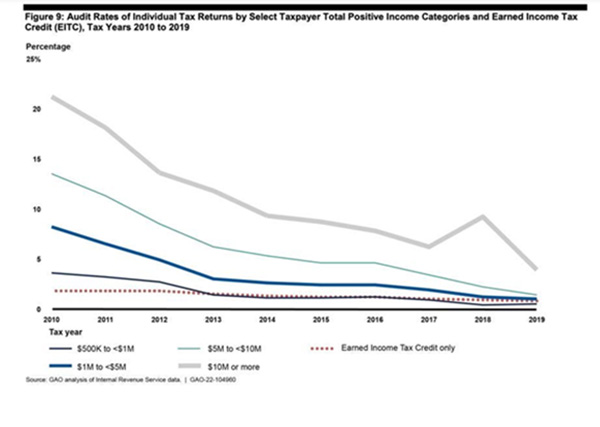
 We’re all feeling the pain at the pump. Unless you decide to walk, bike or take public transportation, you might feel stuck. But all is not lost. Here are some fuel-efficient driving techniques that can help you save hundreds of dollars in fuel each year.
 COVID-19 impacted the economy dramatically and commercial real estate was no exception in terms of decreased values. Often, the real property could no longer service the debt used to finance it. This debt restructuring and resulting debt forgiveness can result in taxable income.